
CRM and ERP
Contacts, quotations, orders, stock and invoicing in one system with proper links between them, so a closed sale updates stock and receivables without anyone re-keying it.
Off-the-shelf tools assume a process you do not have. We build the system your operation needs — inventory, billing, approvals, VAT — and hand you the source code.
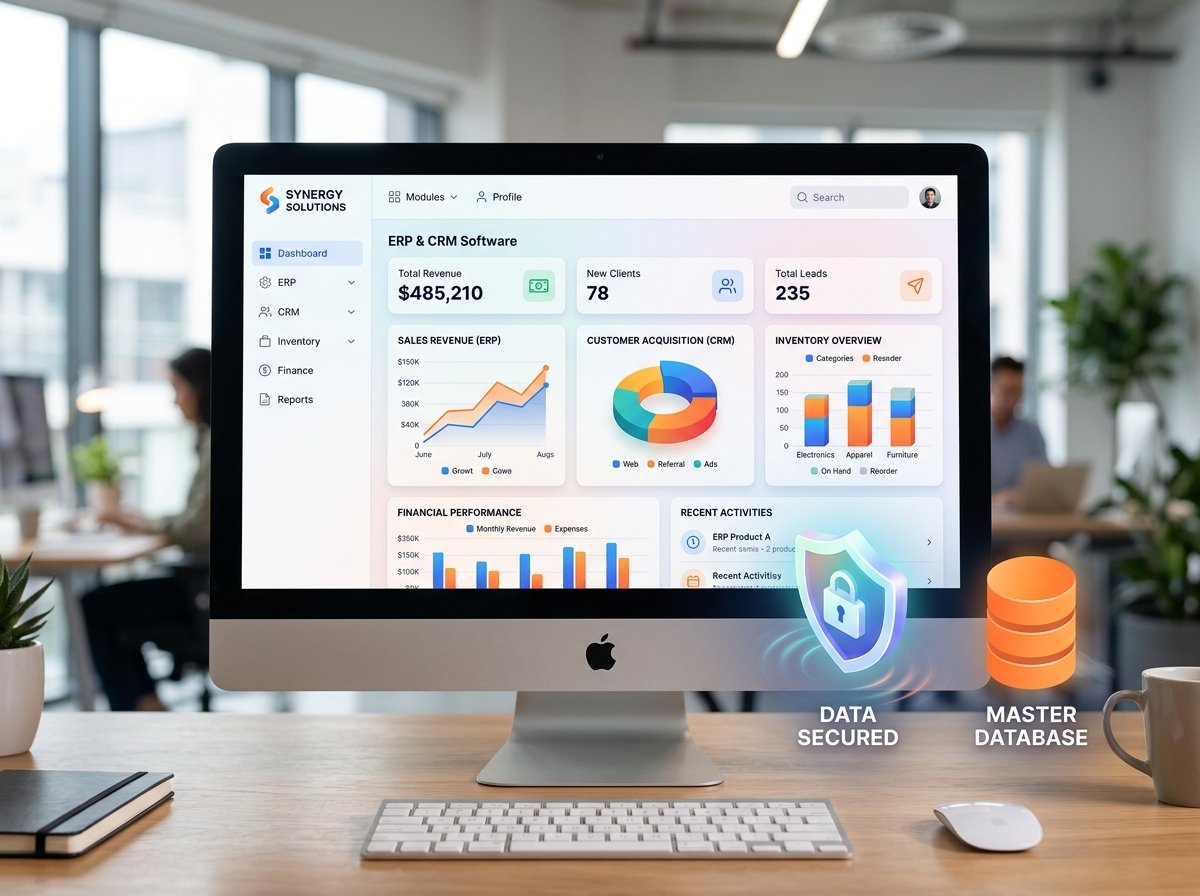
Every growing company here reaches the same point. The order book lives in one spreadsheet, stock counts in another, and finance reconciles both at month end. Staff copy figures across because that is faster than asking IT. The result is a process that only two people fully understand and nobody can hand over. We sit with your team and rebuild that logic as proper software, starting from your documents rather than a generic feature list.
We write it in Laravel and PHP, structured so your next developer can pick it up, and we run each stage as a working demonstration rather than a status report. Omani VAT at five percent is calculated and reported properly, approval chains follow your real authority limits, and every action leaves an audit entry. You own the repository, the database design and the documentation from the first commit.
Every engagement includes documentation, handover and a named contact.
Six modules that replace the spreadsheets and legacy tools holding your operation together.
Contacts, quotations, orders, stock and invoicing in one system with proper links between them, so a closed sale updates stock and receivables without anyone re-keying it.
Multi-location stock with barcode scanning, goods-in and goods-out, reorder thresholds and stock valuation. Bin transfers and adjustments are logged with the reason and the user.
Availability rules, resource allocation, deposits and reminders for salons, clinics, workshops and service bays, with a customer-facing booking page in Arabic and English.
Invoices, credit notes, recurring billing and sequential numbering with Oman VAT at five percent applied correctly, plus the summary your accountant needs at filing time.
Permission levels per role, approval limits by amount, and a log recording who changed which record, when, and what the value was before.
Executive views of revenue, margin, receivables and stock movement, with drill-down to the underlying transaction and scheduled report delivery by email or WhatsApp.
Repository, database schema, documentation and deployment scripts belong to you from the first commit. No licence, no per-seat fee, and no dependency on us to keep the system alive.
Five percent VAT, treatment of zero-rated supplies, credit notes and fiscal period handling are designed into the schema rather than patched in later by a consultant.
Your existing data is mapped, cleaned and moved with a rehearsed cutover and a rollback path. We run old and new in parallel until you trust the numbers match.
We design for the connectivity you actually have, with sensible caching, compressed assets and mobile layouts that stay usable on a warehouse connection rather than office fibre.
Modules ship in priority order, each one live and in use before the next begins. If the budget stops after module two, you still have a working, valuable system.
Stock, invoicing and receivables across multiple branches with margin visibility on every product line and customer.
Work orders, technician scheduling, purchase approvals and VAT-compliant invoices against contract value.
Job cards, parts consumption, service history per vehicle and warranty claims with photo evidence stored against each repair.
Patient records, appointment scheduling, dispensing stock and insurance billing with controlled access per branch.
Bill of materials, production orders, material consumption tracking and costing per batch with variance reporting.
Course cohorts, fee schedules, attendance, instructor payouts and parent or guardian communication through WhatsApp.
Five stages, each ending with something you can click on rather than a progress report.
We interview the people doing the work, study your forms, spreadsheets and reports, and document the rules that actually apply, including the ones nobody wrote down.
We build screens for the two or three most important workflows so you can judge the logic in a browser. Changes at this stage are cheap, which is exactly why we encourage them.
Modules are developed in fortnightly cycles with a test pass against a written acceptance checklist signed by the people who will actually use the system.
Old data is cleaned, mapped and imported in a rehearsed run. We go live alongside the old process, verify the figures, then switch and keep a rollback path open.
Role-based training for staff, written operating guides, and a technical handover covering your codebase, database and deployment. Support is then available on a retainer.
A focused module such as invoicing or booking typically runs from a few thousand OMR. A full CRM or ERP is priced per phase after discovery, with a fixed price per phase rather than an open hourly meter. You get that breakdown before we start, and nothing starts without your sign-off on it.
Buy one if it fits. Off-the-shelf tools cost less and start faster when your process is close enough to the default. Custom work is justified when you have modified a system so far it no longer fits, when invoicing or VAT logic is specific to Oman, or when your data cannot sit on a vendor platform outside the region.
A first usable module is typically live in four to eight weeks, and the system grows in phases after that. We scope to a release order agreed with you, prioritising what removes the most spreadsheet work. Full ERP rollouts usually run three to nine months depending on how many branches and modules are involved.
Yes, both of them. The repository, database design, documentation and deployment setup are all delivered to you, and we hand over the hosting credentials and environment keys as part of go-live. There is no per-seat licence, no vendor lock-in, and nothing stops working if you decide to change developers later.
Both are first-class. The interface, printed documents, emails and notifications are fully bilingual, Arabic is the default right-to-left layout, and numbers, dates and currency follow Omani conventions. Users can switch language per session without losing their place in the workflow.
We offer a support retainer covering monitoring, backups, bug fixes and a monthly block of change requests, because real usage always surfaces gaps a UAT pass cannot predict. Some clients prefer no retainer and simply call us when needed. Either way the documentation and handover are complete from day one.
Connect your ERP, payment gateways, and cloud apps with stable API and webhook integrations built from Muscat for Oman and GCC businesses.
Dastgir IT Services delivers AWS, Google Cloud and DigitalOcean hosting, low-downtime migration, restore-tested backups and 24/7 monitoring in Oman.
Online stores wired to Thawani, BenefitPay, Stripe and PayTabs, with Omani courier tracking included. Start selling with Dastgir IT Services today.
A few details are all we need to get started. Fields marked * are required.
Send a short description of the process and we will tell you honestly whether custom development is the right answer or a cheaper fix would do.
We reply during Oman business hours, Sunday to Thursday. · +968 9651 5039 | +968 9355 7155
50+
Websites Delivered
10+
Mobile Apps
100%
Client Satisfaction
Oman Focused
Local Support